
The Rheinmetall Curb Charger
Robust. Space-saving. Modular scalable.
Red Dot Design Award "Innovative Design"
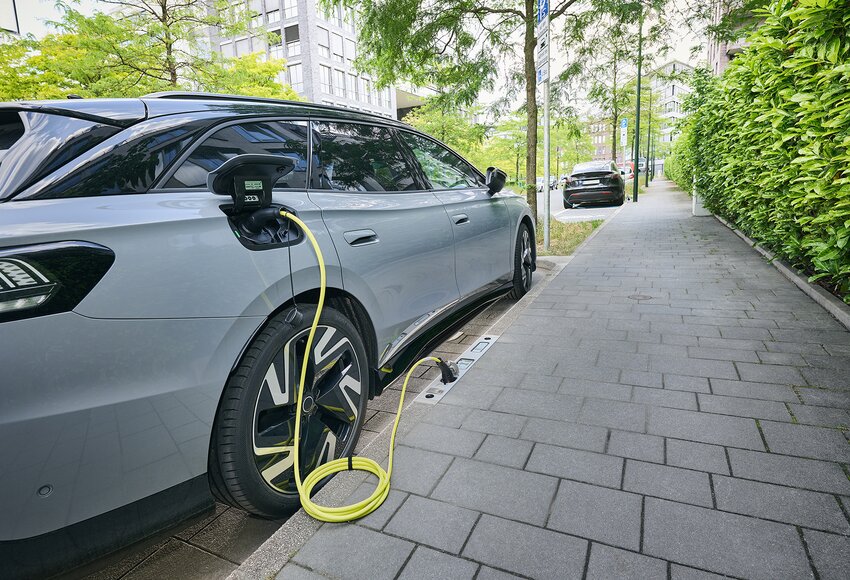
With its innovative approach, Rheinmetall is unlocking a completely new dimension of electric charging. By utilizing existing urban infrastructure and delivering high charging performance, a fully-fledged alternative to conventional charging stations is presented.
In particular, the Curb Charger helps solve the problem of limited space in both urban and rural areas and enables a quick, easily expandable, and cost-effective installation of new, publicly accessible charging points.
We need your consent to load the YouTube service!
In order to play YouTube videos, a connection to YouTube must be established. This will also entail data processing and cookie usage by YouTube/Google (possibly also out of the USA). By clicking "Accept", you consent to this data processing and the placing of YouTube cookies on your terminal device. Your selection will be saved for future visits to this website. You may find further information under "More" and in our Data Protection Information.
- Up to 22 kW charging power
- Compliant with calibration law
- Intuitive one-hand operation without curb contact
- Integrated 4G modem and Ethernet
- Intelligent load management
- Authentication via RFID, QR code, or operator app
- Cooling and heating concept for reliable operation in all seasons
- Reliable operation in rain through encapsulated electronics (IP68)
- Easy retrofit and maintenance through replaceable electronic module

The Rheinmetall Curb Charger was developed for easy installation as well as fast service and main- tenance. Via CurbSwap, the installed electrical module can be completely removed from the curb and replaced with a spare module. A quick connector re-estab- lishes the module connection to the low-voltage network in no time.
The result: significant cost savings during civil works and electrical installations through the use of dummy curbs across larger areas – while minimizing downtime per charging point during maintenance.

Equipped with standardized interfaces,an inte- grated 4G modem, and Ethernet, the Curb Charger takes communication to the next level. Data is seamlessly exchanged between the charger and backend sys- tems via the certified OCPP 1.6 communication standard.
The advantage: real-time insights into charging sessions, cus- tomer reservations, and chargepoint status – plus the ability to perform over-the-air software updates. This ensures the Rheinmetall Curb Charger is always up to date with the latest technological developments.

A carefully engineered cooling system ensures reli- able operation even at high ambient temperatures and prevents overheating. In addition to targeted heat dissipation, integrated temperature monitoring guarantees optimal charging performance.
At sub-zero temperatures, a built-in heating system ensures visi- bility and reliable, snow- and ice-free operation of the charger.

Encapsulated electronic components (IP68) and a sealed charging socket with integrated water drains ensure reliable charging, even in wet conditions. If water accumulates on the street and could compromise safe charging, a water level sensor interrupts the process before the residual current device (RCD) is triggered.

In the event of an electrical fault, integrated surge protection and continuous contactor welding and PE (protective earth) monitoring provide additional safety for people, electric vehicles, and connected systems.
| General information | |
|---|---|
| Charging mode | Mode 3 charging according to IEC 61851-1 |
| Charging connector | Type 2, Case B |
| Authorization | Open charging, RFID, operator app, QR code |
| Mechanical data | |
|---|---|
| Material | Curb: concrete; Electronics module: stainless steel & aluminum |
| Locking | Socket flap, unlocked upon authorization at the curb or through the app |
| Dimensions (L x B x T)* | 1,000 x 250 x 120/150 mm³ (other curb sizes available on request) |
| Weight | approximately 80 kg |
| IP protection rating | IP54 (entire system), IP68 (encapsulated electronic unit) |
| IK protection rating | IK10 |
*Dimensions may vary due to tolerances
| Electrical data | |
|---|---|
| Max. charging power per charging point | up to 22 kW |
| Nominal voltage, current, frequency | 3x230V/400V+N+PE, 32 A, 50 Hz |
| Protection | 6 mA DC fault current detection |
| Surge protection | Typ 2 + Typ 3 |
| Connectivity | |
|---|---|
| Communication protocols with IT backends | OCPP 1.6 |
| Communication | Integrated 4G modem, Ethernet, RFID |
| User Interface | Status information through LED display, operator app |
| Display | Externally readable, calibrated energy meter (MID-compliant) |
Service portal

Contact

Curb chargers
Phone: +49 2131 520 01

Spare parts ordering, training requests and technical information I Curb chargers
Germany
Phone: +49 2133 267 177