
jumpToMain
38677

Business Partner Management

Third Party Assessment

At Rheinmetall, business partner verification or third party assessment means a series of background analyses conducted on a potential business partner (so-called Third Party Assessment) prior to as well as after the conclusion of the contract (so-called Third Party Monitoring). The focus is on excluding potential Compliance risks being introduced to the company through the “back door” by contracting an external party.

Such risks can include criminal or unethical conduct on the part of the business partner, opaque ownership structures allowing for tax evasion or money laundering, or conflicts of interest in relation to competitors, customers, bureaucratic structures, political parties or with Rheinmetall personnel. Although the defense and automotive sectors have different risk emphases, the importance of early detection of possible critical scenarios is always paramount.

608

At Rheinmetall, business partner due diligence is conducted on the basis both a risk-scoring mechanism as well as a division of labor procedure between central and decentralized Compliance teams.

Our "Business Partner Policy" is applicable for all Rheinmetall companies, including our joint ventures.
Integrity along the entire Value Chain

To protect the company's reputation and to ensure cooperations built on the basis of trust Rheinmetall expects its suppliers, service partners, sales partners and customers to follow the same behavior and share the same basic attitude. This shared understanding was therefore condensed into our Supplier Code of Conduct (target group = suppliers and service providers) and Business Partner Code of Conduct (target group = intermediaries and re-sellers) which must be confirmed by all of the respective business partners on a mandatory basis.

Integrity is therefore an essential selection criterion for cooperating with all kinds of business partners along the entire value chain.

Screening our Supply Chain
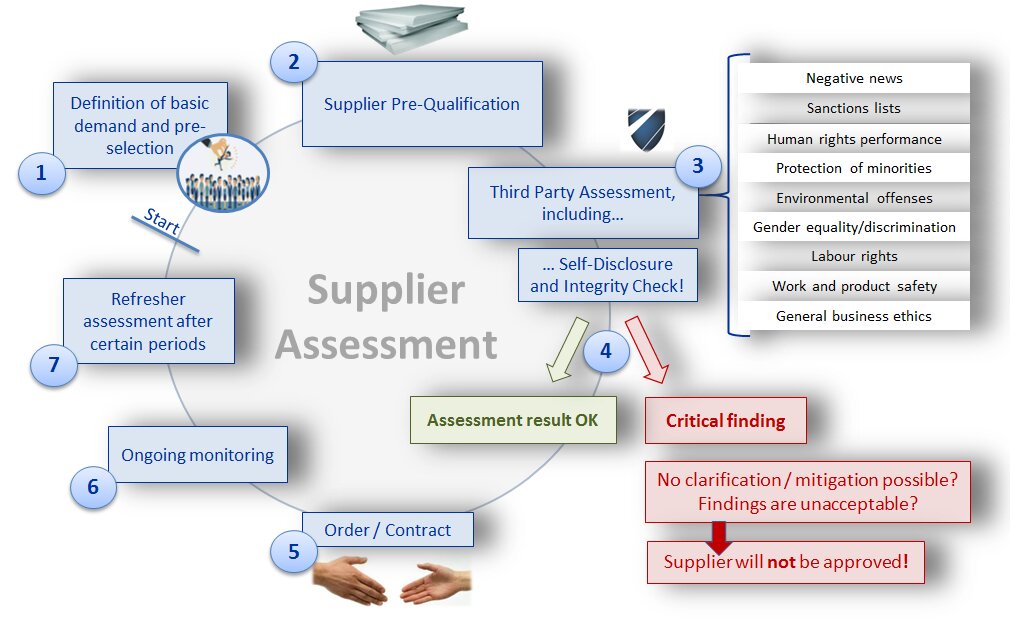
The Rheinmetall Group pursues a structured process for the qualification of new suppliers including the assessment of Compliance-related risk factors. The following graphic shows the overall approach.
621

The process begins with the supplier self-assessment factoring in various commercial, technical and other parameters. On the basis of this data, we evaluate the general suitability of the supplier. This initial assessment is later supplemented by supplier audits.

These assessments not only include a thorough validation of the supplier's policies, processes and general commitment to ensuring Compliance. We also conduct thorough background checks of:
 

  • KYC factors such as name, registration, ownership and management
  • Track record in the relevant line of business / contractual scope
  • Integrity and transparency of the business partner and its affiliates
  • The supplier’s performance on ESG aspects such as human rights, labor rights, occupational safety, gender equality, anti-discrimination and environmental protection.
Involving important Interfaces

As Compliance is not a one-man-show, it is paramount to involve multiple important interfaces within the company when it comes to third party Due Diligence:

  • Management bodies that are responsible for the implementation of the policies in terms of personnel, organization and administration
  • Departments outside the Compliance Organization that are in direct contact with business partners (e.g. sales, purchasing, M&A, export control, project management, marketing)
  • Departments/functions that are involved in the initiation of a business relationship and in the creation of contracts
  • Departments that perform audit or control functions (e.g. legal department, treasury, or export control)
  • Internal Audit to verify compliance with the requirements of this Directive
M&A Due Diligence
Acquisitions, strategic alliances and joint ventures are a central element of Rheinmetall’s ongoing internationalization and growth strategy, in order to improve its market positions, supplement existing business or penetrate new segments. For this, Rheinmetall defines recommended actions based on continuous analyses of the market environment and its own portfolio.

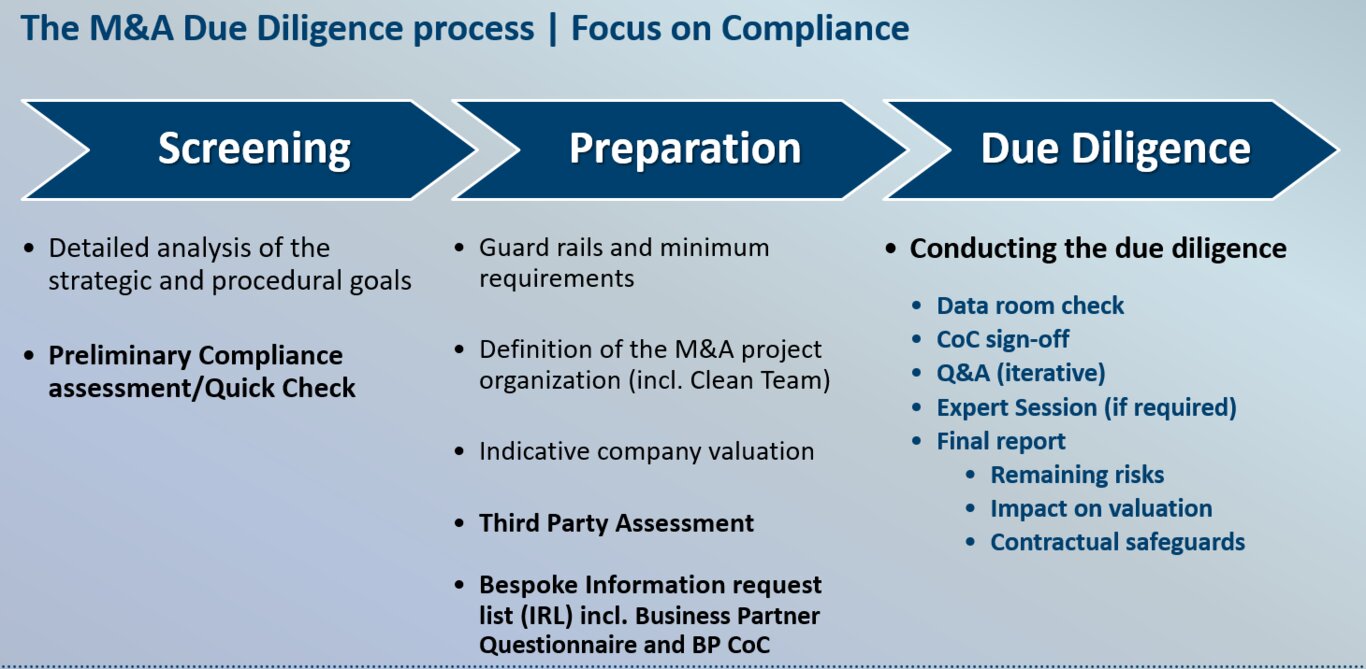
In accordance with group-wide guidelines, potential target companies are subjected to a careful analysis of opportunities and risks through standardized processes such as extensive due diligence procedures and are assessed on the basis of strategic, commercial, operational and financial aspects. Following an approval process carried out over several distinct stage gates, the Executive Board and, where the transaction volume exceeds defined value thresholds, the Supervisory Board of Rheinmetall AG decide on the acquisition project.
38680
Relations to Government, Authorities and Politics
As a Group for leading technologies in mobility and security, we always present ourselves to our customers transparently, impartially, and with the requisite professional distance, regardless of whether customers are from the public or private sector or how far back the business history extends. We only use critically preselected consultants or lobbyists at the interface to politics and authorities. They are subject to the same high compliance standards as Rheinmetall employees themselves.

Rheinmetall Defence has representative offices in Berlin and Brussels. Rheinmetall does not send or employ any staff in ministries. Contributions to democratic political parties are subject to applicable laws and internal, often stricter compliance regulations. They fall within the remit of Rheinmetall AG's Executive Board, which restrictively handles approvals.

We conduct lobbying in accordance with the rule of law as well as the principles of openness, traceability and accountability. Neutrality in dealing with political parties and interest groups is a matter of course for us. Unfair influence on politics and legislation is not permitted.
626

Rheinmetall Platz 1

40476 Dusseldorf

Germany

Contact us

© 2026 Rheinmetall AG