jumpToMain
192782

World Health Day

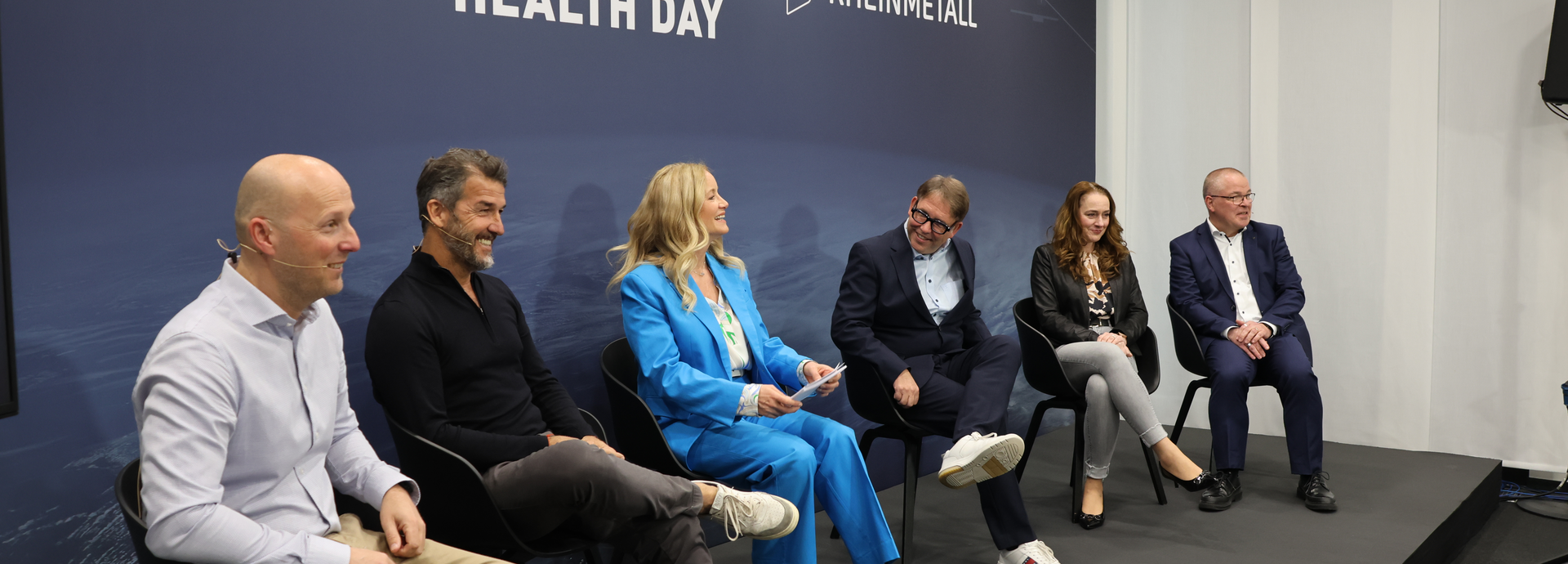
A panel discussion for World Health Day 2026 with former professional footballer, World Cup champion and BVB legend Karl-Heinz Riedle, health economist Prof. Dr. Volker Nürnberg, whose areas of expertise include health prevention, Julia Stump from Rheinmetall’s sustainability team; Rheinmetall Vice President Corporate Health Solutions Carolin-Ann Schmitz; Rheinmetall Senior Vice President Corporate Marketing Daniel Brocker; and occupational social counsellor Jan Hübenet.

Resilience is on everyone’s lips — in the workplace, in health discourse and in debates about social crises. The term originated in physics and refers to the ability of materials to return to their original state after being subjected to stress. Since the 1950s, resilience is also being studied in psychology. The central question is why some people are better able to cope with stress, crises and setbacks than others. The panel made one thing clear: resilience is far more than individual toughness. It has many dimensions and concerns not only individuals, but also organisations and society as a whole.

Daniel Brocker:

“Our colleagues at Rheinmetall deserve great recognition for their work over the past few years. I have been with the company for almost 14 years and have seen how much we have changed over the past four years. Against the backdrop of the geopolitical situation, the perception of what we do has also changed massively. Today, Rheinmetall is much more present in the public eye — and, of course, so are the people who deliver immensely here every day.”

Carolin-Ann Schmitz:

“Health management at Rheinmetall follows a shared, overarching strategy. At the same time, our individual sites are set up very differently. This strategy provides the framework in which everyone can see themselves reflected. However, the specific offerings must be target-group-oriented and tailored to the individual sites themselves. Low-threshold services are crucial, so that each individual employee can make use of whatever they need at that particular moment.”

Jan Hübenet:

“We currently have 60 social counsellors active in Germany. In 2025, we supported and advised 250 employees and referred them to suitable partners from our network. People come to us with a wide range of problems. Our original focus was addiction counselling, but today that is only a small part of what we do. Mental health has become a much stronger focus. Demand was particularly high during the pandemic, when family-related and social pressures increased significantly.”

Karl-Heinz Riedle:

“Football has not only changed technically and become much faster — the support around players is also far more comprehensive today. In my day, there were no psychologists or experts looking after players’ mental health. Yet there would have been many situations in which that would have been helpful — for example, when you are sitting on the bench, not being substituted in during a match, or returning after an injury. Young players in particular need support. Today, this is organised much better. At the same time, the demands placed on professionals have also increased enormously — not least because social media puts them much more in the public eye.”

Volker Nürnberg:

“Contrary to popular belief, people do not primarily have a problem with stress, but with recovery. In football, professionals are initially rested after a tough match — in companies, that is not possible in the same way. That is why managers are so important, especially at the lower levels. They are a key factor in employees’ wellbeing. Conversely, however, it is also true that managers are one of the most common reasons for resignation in Germany.”

Julia Stump:

“Last year, I was diagnosed with breast cancer — highly aggressive and completely out of nowhere, with no genetic predisposition. At first, I spent two or three days in a kind of state of shock, trying to process it. After that, I quickly switched into action mode. My family was an incredibly strong source of support. At the same time, I experienced great support from my manager right from the start. Together, we looked at how my responsibilities could be distributed across several shoulders. It was clear to me early on that I wanted to continue working — also because, alongside my family, work gave me support, structure and stability.”

Rheinmetall Platz 1

40476 Dusseldorf

Germany

Contact us

© 2026 Rheinmetall AG