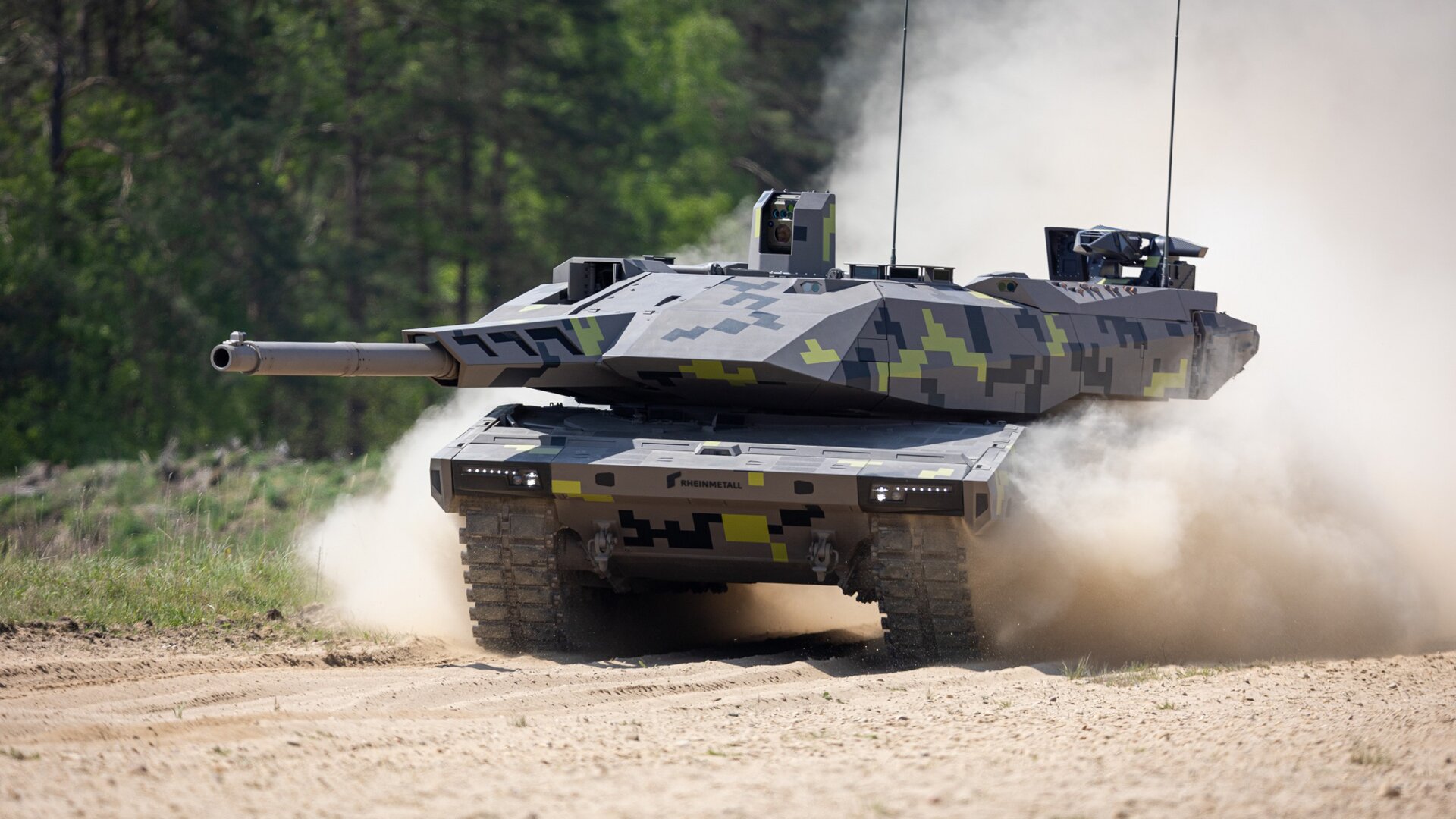
Panther KF51 main battle tank
Future tanknology
New MBT concept
- highest lethality on the battlefield, combined with an
- integrated survivability concept and connected by a
- fully digitised NGVA data backbone to enable
- next-generation operational capabilities and automation.
This enables a reduction in crew size, which paves the way for uncrewed turret options and Human-Machine Teaming.
Highly lethal
Unrivalled lethality overmatch with the 130 mm Future Gun System (FGS) and optimised sensor-to-shooter links.
Highly protected
The first MBT adopting an integrated survivability concept of on and off-platform sensors coupled with active, reactive and passive protection and a dedicated top attack protection system.
Fully digitised
The first for an MBT: The Panther is designed around a digital architecture complying with the NGVA standard. This is the key enabler for future decision support and automation systems.
Rheinmetall releases Panther KF51 Main Battle tank
We need your consent to load the YouTube service!
In order to play YouTube videos, a connection to YouTube must be established. This will also entail data processing and cookie usage by YouTube/Google (possibly also out of the USA). By clicking "Accept", you consent to this data processing and the placing of YouTube cookies on your terminal device. Your selection will be saved for future visits to this website. You may find further information under "More" and in our Data Protection Information.
Lethality
Rarely has the sheer power of an MBT gun been more impressive. The Future Gun System, developed by Rheinmetall, enables a 50 per cent longer kill range to be achieved (than 120 mm) with an unrivalled rate of fire due to the autoloader performance. A 12.7 mm co-axial machine gun complements the main gun. Multiple Remote Controlled Weapon Station (RCWS) integration options give flexibility in proximity and drone defence. The optional HERO 120 loitering ammunition capability expands the Panther’s strike capability to non-line-of-sight targets and can be mounted depending on role and mission requirements.
All weapons are connected with targeting sights and the fire control computer through the fully digitised architecture, allowing for hunter-killer and killer-killer operation, seamless target engagements and future AI decision support.

Survivability
The Panther is configured with a pre-shot detection capability, enabling it to strike first. Threats from above are defeated by the Rheinmetall TAPS (Top Attack Protection System). The ROSY smoke obscurance system is provided as part of the survivability system, which fully integrates with the digitised architecture to allow additional defence measures. The standout survivability feature is undoubtedly the active KE protection, which increases protection levels without affecting the system weight.
As a system designed to operate in a contested electromagnetic spectrum, the Panther is fully cyber hardened.
-
Reactive and passive protection
- Sensor-based reactive system
- Passive protection
- Actice protection
- Protection against large-calibre KE
- Protection against ATGM
-
ROSY smoke obscurance system
-
Top attack protection system (TAPS)
-
Mine protection
-
Rheinmetall drones
-
Pre-shot detection capability
Tactical and strategic Mobility
Combat weight: < 59 t
Range: > 500 km
Fits tunnel profile AMovP-4L 9 t
The Concept
The Panther is designed to control assigned uncrewed aerial vehicles such as on-board or off-board drones, loitering ammunition and a range of uncrewed ground vehicles.
The fully digitised system and common crew stations are the enablers for true Human-Machine Teaming and control of wingman UGVs that cover capabilities such as platoon-level air and drone defence.
Commandability
The Panther is designed for a crew of three, supporting future force structures with reduced numbers of soldiers. Two crew stations are located in the chassis, with one dedicated to the driver and an optional station dedicated to a company commander, a drone operator or a wingman pilot.
The fully digitised NGVA architecture allows for seamless sensor and effector integration both within the platform and cross-platform. Sensor and weapon control assignments can be passed between crew members instantly. Each workstation can hand over and take over tasks and roles from others with no reduction of functionality. As the turret and weapons control are also provided to the chassis based work stations, future upgrades being planned include uncrewed turrets and remotely operated Panthers.
Partnership potential
Join the Panther Leap and help jointly shape the system.
By engaging with Rheinmetall’s innovative development approach, operators, maintainers, logisticians and procurement professionals of all current and future user nations can enable the future – together shaping the Panther habitat.
Rheinmetall has pedigree in creating global product supply chains and engaging with user nations in order to provide substantial national industrial content and sovereign capability.
Image gallery
News
Download
Phone: +49 5827 80-02