24.04.2026 | Story
Modern munitions at speed: Rheinmetall's full-spectrum approach to munitions and energetics readiness
Modern conflict has fundamentally reshaped both the requirements placed on munitions providers and the speed at which those capabilities must be delivered. For decades, the U.S. defense industrial base accepted prolonged development timelines, structured production across fragmented contractor networks, operated without a single entity accountable for full lifecycle integration, and relied on surge capacity that remained largely theoretical rather than operationally viable.
Addressing those shortfalls and accelerating domestic production calls for a different production model, one the current administration is intent on building.
A new era for soldier lethality
“Insufficient modernized capacity and gaps in advanced capability remain the primary constraints,” said Chris Battagliese, Senior Director of Business Development at American Rheinmetall Munitions. “The challenge is delivering at speed, scaling for surge, and designing munitions that are optimized from the outset.”
As a lead systems integrator, Rheinmetall has addressed these challenges globally by advancing capabilities across the full energetics value chain – from facility design and propellant formulation to projectile and propellant production to demilitarization, decommissioning, and disposal. American Rheinmetall Munitions is now positioned to apply that integrated, full-spectrum model to the U.S. defense industrial base with the speed and scalability current requirements demand.
Modernization in action: Rheinmetall's munitions innovation
Developing munitions in isolation from the systems that employ them creates performance gaps that increased production alone cannot resolve. When designers fail to integrate the munition with the weapon system, fire control, and operator requirements from the outset, overall effectiveness is inherently constrained. Rheinmetall has taken a different approach. It designs munitions as part of an integrated system, aligning the projectile, launch platform, fire control, and operational considerations from the beginning rather than attempting to reconcile them after the fact.
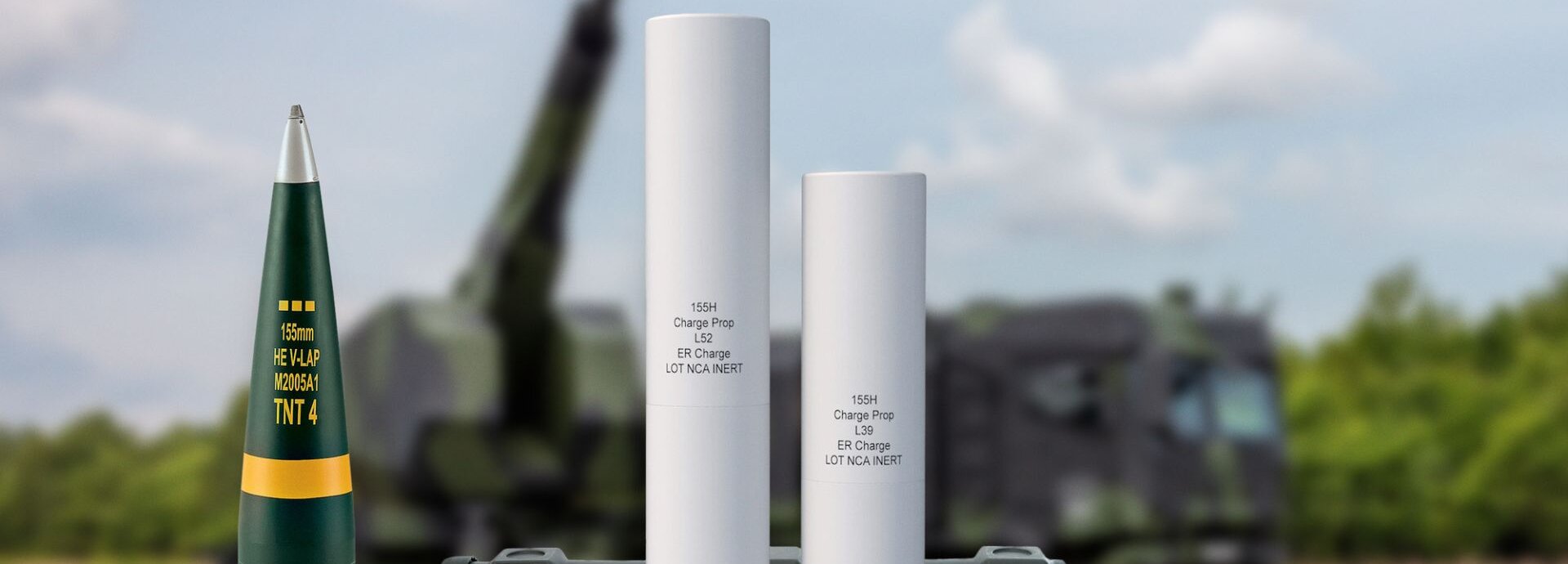
Rheinmetall’s 155mm supercharge propellant is one example. As the Army moves toward a wheeled Mobile Tactical Cannon (MTC) to replace the M777 towed howitzer, range performance becomes a defining requirement. Rheinmetall engineered the supercharge propellant to align with its L52 cannon’s pressure specifications. This enhances the effective range of precision-guided munitions by offsetting the range reduction typically caused by course-correcting fuzes. Designed for compatibility with both current and next-generation cannon lengths – including those anticipated for the L52 Mobile Tactical Cannon – the supercharge enables munitions to achieve new range thresholds.
For the U.S. dismounted Infantry Soldiers, Rheinmetall’s 40mm medium velocity (MV) cartridge carries the same integrated design philosophy into a fundamentally different role. It serves as the foundation of the Precision Grenadier System (PGS) it was designed to support. Developed from mature fuze technology and high-velocity propulsion scaled for the shoulder-fired role, the MV cartridge produces a flatter trajectory and shorter time of flight than conventional low-velocity 40mm rounds, translating directly to first-hit precision at extended ranges and the capability to place multiple rounds on target in rapid succession with greater lethality than 25mm and 30mm shoulder fired weapons.
Brent Martin, Business Development Manager at American Rheinmetall Munitions, sums it up best. “It delivers the precision and lethality Soldiers need, and the mature fielded system can immediately provide the U.S. government with weapons and a family of ammunition,” he said.
Rheinmetall's SSW40 shoulder fired automatic grenade launcher, MV rounds, and a purpose-built fire control with CUAS tracking software is a mature system of systems currently fielded in NATO countries. The full MV portfolio of ammunition comprises 10 different round variants, including High-Explosive Fragmentation with Airburst Capability (HEAB), Multi-Mission rounds and High-Explosive Dual-Purpose (HEDP) for use against light and medium armor with the ability to penetrate four inches of RHA, and ballistically matched training rounds.
For the U.S. Army’s Precision Grenadier System (PGS) program, Rheinmetall has developed the "Highly-Advanced Multi-Mission Rifle". Built on the SSW40 platform, the Highly-Advanced Multi-Mission Rifle meets Army requirements for rate of fire and effective range while remaining below established weight thresholds. The 40mm MV cartridge and the Aimpoint FCS15 fire control system were developed in parallel with the weapon, with each component optimized as part of an integrated system from inception rather than procured independently and integrated after the fact.
By extending effective engagement range, the Aimpoint FCS15 enhances the overall capability of the system at the Infantry squad level. The Highly-Advanced Multi-Mission Rifle also maintains compatibility with all qualified 40mm low-velocity (LV) munitions currently in the U.S. Army inventory, reducing integration risk and preserving existing logistics. The system combines increased lethality with improved survivability by enabling engagements at greater stand-off distances, while maintaining a recoil profile that supports sustained, effective fire. Notably, the FCS14, which serves as the baseline for the FCS15, is a Technology Readiness Level 9 system already in operational use with the U.S. Marine Corps.
“We’ve taken the approach to create a system of systems (weapon, fire control, and munitions) developed side by side to maximize component effectiveness and lethality. This approach ensures our Soldiers have the capabilities they need to maintain battlefield overmatch.”
Vice President of Business Development at American Rheinmetall Munitions, Inc.
Speed to market: Delivering at operational tempo
Russia's invasion of Ukraine exposed just how quickly modern conflict consumes ammunition, and how poorly most Western industrial models were positioned to respond. Both sides fired artillery at a scale that exceeded NATO's planning assumptions, draining stockpiles, and revealing how dependent allied nations had become on production infrastructure that could not meet surge requirements.
Rheinmetall recognized the gap early and moved fast. Its new Lower-Saxony plant in Unterlüß, Germany, capable of producing up to 350,000, 155mm projectiles per year, was constructed in 15 months. Meanwhile, a major modernization of its Aschau, Germany, energetics facility delivered a 40% increase in multi-base propellant production capacity in 18 months, and the acquisition of its Hagedorn nitrocellulose plant added further European propellant capacity.
The response extended beyond artillery. Rheinmetall simultaneously scaled production across tank and medium-caliber munitions in record time, addressing the full spectrum of consumption rates that modern conflict exposed. Rheinmetall now has 13 factories under construction globally, with its total munitions and energetics production footprint spanning 46 facilities worldwide.
"In the United States, major modernization efforts take upwards of six years. We did it in 18 months," Battagliese said, referring to the German energetics facility modernization. "That is unheard of in the U.S."
Its speed comes from how Rheinmetall scales production facilities. Proven facility designs covering energetics and artillery shell production, energy and emissions planning, environmental controls, and modular system configuration are adapted and deployed for each new facility rather than built from scratch. From an engineering standpoint, everything is digitized from the start of each deployment, giving facility operators real-time visibility into production processes and the ability to identify and correct problems before they compound.
Battagliese also points to Rheinmetall’s partnership strategy in delivering speed:
“We believe in using specialized partners in very targeted ways so that we do not sacrifice speed. We are not going to add people to our team just to show we have a larger team. Speed is the name of the game, and that means knowing when your partners' expertise gets you there faster than building your own team would.”
Senior Director of Business Development at American Rheinmetall Munitions, Inc.
The full ammunition eosystem: Rheinmetall as a systems integrator
The existing fragmented ecosystem for munitions capabilities – where propellants, casings, and components are developed and procured by separate contractors with minimal coordination – has proven inadequate for ensuring the readiness of the industrial base. Getting the right capability to the Warfighter faster requires control across the full lifecycle, from research and development through design, testing, production, integration, and sustainment.
As a lead systems integrator, Rheinmetall maintains that control in house.
"The Army has long preferred to act as lead systems integrator, parsing out artillery propellant to one contractor, combustible cases to another, and metal parts to another. While this has fostered competition necessary in the market, a compromise of that approach is speed and potentially system performance,” Russel said. “Because we are vertically integrated, we optimize the propellant, fuse, casing, delivery platform – all are developed together and optimized with each other. The performance speaks for itself, and so does the fielding timeline. In addition to this, we optimize the propellant and projectile to the cannon to ensure maximum range is achieved.”
The "Highly-Advanced Multi-Mission Rifle" solution demonstrates what Rheinmetall's systems integration looks like in practice. A weapon system developed across multiple contractors – with ammunition from one, fire control from another, and the weapon platform from a third – would still be mired in integration testing, with each supplier managing its own schedule and its own supply chain, not to mention its own production constraints. When demand surges or components need to be replaced at scale, those seams become the problem. Rheinmetall controls the full lifecycle, which means there are no seams to manage.
American Rheinmetall Munitions: Bringing the proven system home to the U.S.
American Rheinmetall Munitions is translating Rheinmetall's global model into U.S.-specific programs, onshoring the same facility design expertise and production methods that delivered results in Europe to the requirements of the domestic defense industrial base. And the need is urgent. The U.S. currently depends on a single plant in Canada to produce the artillery propellants used in the U.S. military’s modular charge systems. The only domestic facility capable of producing single, double, and triple base propellants is the Radford Army Ammunition Plant in Virginia, a facility where the infrastructure is aging and the manufacturing processes, in many cases, date back more than 50 years.
Rheinmetall has been in this position before. It has repeatedly taken underperforming assets and brought them to full production capacity at a pace the traditional U.S. procurement model has not been able to match. In the U.S., recent Army testimony before the House Armed Services Committee identified navigating complex permitting requirements, workforce development, and coordination across federal, state, and local agencies as systemic barriers to expanding domestic munitions production. American Rheinmetall Munitions is already drawing directly on lessons from Rheinmetall's global deployments to address them, conducting site assessments and engaging with the regulatory and infrastructure considerations specific to domestic energetics production.
"The lessons we have learned designing around constrained infrastructure overseas are directly transferable to what we will find at sites like this," Battagliese said, referring to the Radford plant. "That kind of experience is exactly what older U.S. facilities require." And Russell added:
“This is not about making promises for some distant future. We have a proven track record that includes 13 factories under construction globally and facilities delivered and operational in months, not years.”
Vice President of Business Development at American Rheinmetall Munitions, Inc.
Ready to deliver
Rheinmetall has redefined what it means to be a munitions supplier. Its model is built on full lifecycle control, from the propellant and the projectile to the fire control system and the facility that produces them, delivered at a pace the traditional procurement model has not matched.
And now American Rheinmetall Munitions is building that future on American soil, translating Rheinmetall's global track record into U.S. capability at the speed the defense industrial base demands. The administration has called for a fundamental change to the way munitions are sourced and produced. American Rheinmetall Munitions is ready and able to answer, at speed and at scale, for the United States now.
Further information
Learn more about Rheinmetall subsidiary American Rheinmetall Munitions, Inc. here.


Head of Public Relations
Phone: +49 211 473-4748

Deputy Head of Public Relations / Spokesperson Vehicle Systems & Weapon and Ammunition
Phone: +49 211 473-4287