E-Learning – Army
With digital training to mission readiness
Whether handling personal equipment or driving, operating, and maintaining military vehicles: the complexity of individual processes and entire systems requires specialized knowledge, detailed understanding and confident handling. Practical training with actual equipment is highly time-consuming and costly. Digital training provides a resource-efficient, efficient, and scalable way to rapidly and securely educate personnel, enabling earlier utilization of the system. Rheinmetall's subsidiary, benntec, develops contemporary digital learning applications for essential basic and specialized knowledge, specifically preparing vehicle operators, maintenance personnel, and instructors for their real tasks and operational environments.
- Efficient use of training time through independence from location, time, and original equipment
- Individual, versatile, and flexible complement to the curriculum (blended learning)
- Simultaneous training of many individuals, instructor-led or self-directed, alone or in teams
- Practical training in a risk-free environment
- Scalable, durable learning solutions (quick adjustments and expansions)
From computer- or web-based training to mobile apps and extended reality solutions with VR and AR, the methods and technologies for digital knowledge transfer are designed based on training needs, target audience, and learning objectives. All learning content is prepared with a didactic approach.
- Effective through the didactic and methodological preparation of learning content
- Attractive and motivating design with interactive features
- Clear presentation of complex facts and sophisticated technology
- Intuitive operation through simple user guidance
- High learning effectiveness through action-oriented approaches
- Alignment with clear learning objectives
- Measurable learning success
Systematic learning through close integration of theory and practice
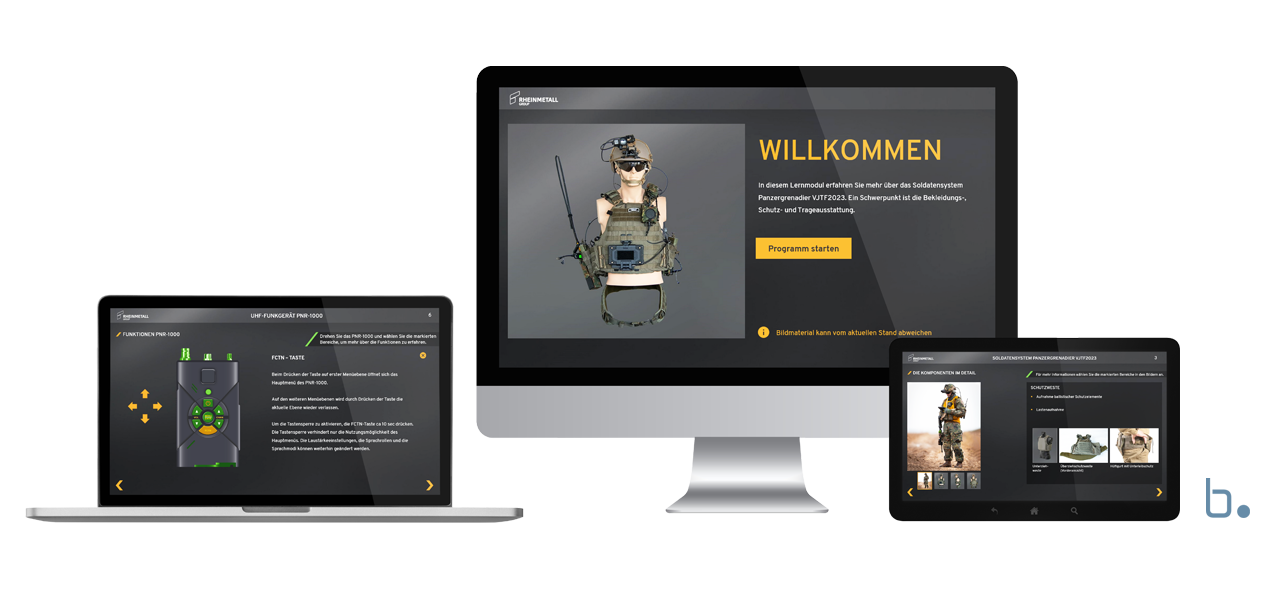
Modular structure: The digital training concept for the Future Soldier System (IdZ – Armoured infantryman – leadership capability component / C4I) follows a modular structure, consisting of 10 learning units, each lasting approximately 45 minutes. The lessons build upon each other in a sequential order, starting with an introduction to the overall system and its exploratory investigation, and then delving into each individual equipment component in detail.
Training objectives: After completing the learning modules, troop members, platoon leaders, and administrators of communication and leadership equipment will be familiar with the structure and functions of the IdZ system and capable of operating all components correctly in the field. This includes handling clothing, protective gear, and carrying equipment, as well as operating electronic components, digital radio technology, and integrated software.
Teaching and learning concept: The knowledge of the system is conveyed on a cognitive-procedural level through animations, videos, screen captures, step-by-step operating instructions and sequences, and various gamified elements, making it accessible and interactive. Action competence is achieved through practical, partially simulated exercises and tasks, ensuring the solidification of knowledge. Modules for assessing learning outcomes help evaluate individual learning progress.
Flexible deployment: The learning modules can be combined in an individual curriculum for different learning groups and utilized multiple times, both for self-directed learning and in instructor-led lessons as a digital teaching aid. They comply with “Bundeswehr” standards for training resources and modern training technology and are SCORM-compatible for integration into learning management systems (LMS).
Understanding technology, increasing safety: From basic knowledge to specialized training
Whether it's wheeled or tracked vehicles: Each vehicle system and vehicle technology present a variety of different challenges for operators and maintenance personnel. When processes and systems are particularly complex or safety-critical, excellent training is essential. The risks encountered in practice are minimized through digital learning technology, which enables vehicle operators and technical personnel to competently handle all systems.
Digital learning programs have a crucial advantage over traditional knowledge transfer: technologies, processes, and procedures can be visualized more vividly – and therefore more memorable – on a screen than on paper. Theoretical foundations and topics that are often perceived as dry, such as behavior, measures, or tactical principles, can be effectively presented through interaction and the combination of various media, such as audio commentaries, explanatory videos, and graphical representations in all forms.
Sophisticated vehicle technology becomes experiential through the use of multimedia elements, making abstract and complex connections transparent and clear. Detailed photos and interactive 2D and 3D models present the structure of each system in an understandable and easily graspable manner at a glance. Assembly constructions can be quickly identified, and internal components become visible. Processes and functions are clarified and explained step by step through cutaway drawings, illustrations, and animations. Exploratory 360° videos, for example, of vehicle interiors and instruments, provide a realistic panoramic overview. The operation of instruments and equipment is efficiently taught through interaction, gamified elements, and simulations that bring real mechanisms into the learning environment, promoting action-oriented training.
Each learning program follows a holistic didactic design concept and is individually configurable and adaptable to the target audience. The foundation of each concept is the technical documentation, manuals, repair instructions, and training materials provided by the respective vehicle manufacturer. The learning content is typically modular, designed as self-contained, topic-based lessons that can be used as guided or self-directed training units depending on the requirements. Each lesson focuses on a specific problem and is linked to a clear learning objective. By combining this with tasks, tests and practical exercises in simulations, the learning content is reinforced, and the learner receives immediate feedback on their progress.
A training concept focused on blended learning, with a balanced mix of practical and theoretical components, can be tailored to the needs of the course participant and the available training duration. With digital learning solutions, course participants can understand, review, and practice content at their own pace. All course participants are uniformly trained, in line with competency-based education, to ensure a safe handling of the systems – not through a “one size fits all” approach, but through tailored, modular learning units that align with the unique circumstances of each participant. The comprehensibility and success of a course can also be evaluated in a more differentiated and transparent manner through digital learning solutions, going beyond the assessment of an instructor alone.
Learning in virtual reality: maximum action orientation, practical relevance and safety
Virtual reality technology is becoming increasingly important as part of modern comprehensive training. In the military environment, VR has a particularly high benefit as a risk-free training environment in conjunction with a digital twin of a cost-intensive water, land or air vehicle.
Dangerous procedures, work processes, and operating steps can be safely learned and practiced virtually with all the necessary maneuvers – even before a new production line is completed, for example. Movements, distances, and size ratios can be easily replicated in the three-dimensional 360° VR environment. Additionally, VR scenarios can simulate various training conditions, such as critical danger situations or terrain and weather conditions.
The use of VR training helps to increase attention and enhance the learning effect. Participants in the course experience total immersion in the digital learning space, as they can fully focus on the training content without any distractions from the outside world while wearing the VR headset. Knowledge is not only passively conveyed; active actions are performed in the virtual world. Through hands-on practice, trainees internalize work steps and procedures in a lasting way. Having “done” something has a significantly higher learning effect than merely having “heard” or “read” about it.
Attack Helicopter TIGER: VR training for technical-logistical personnel
To make the preparation for dangerous procedures as safe and practical as possible, the first virtual reality classroom of the German armed forces (“Bundeswehr”) was established at the DFAT (German-French training facility TIGER in Faßberg). Here, trainees receive fundamental skills in the virtual space on the digital twin of the current Attack Helicopter TIGER version ASGARD. They practice functional tests on various components, perform safety checks, and carry out complex adjustment, maintenance, and repair procedures.
The VR scenarios with different training content offer both self-paced learning, where the trainee moves through the scene at their own discretion (single mode), as well as team-based learning (multiplayer mode) and instructor-led learning. Here, the instructor teaches the learning group directly in the virtual space. Communication and cooperation within the scenarios are made possible through voice connection and the representation of the instructor – or other participants – as avatars.


„I have to admit that I had reservations about VR. However, I quickly became impressed by the thoughtful implementation and the possibilities it offers. Components and functionalities can be realistically provided on the digital twin, just like on the actual helicopter. This is a real added value in terms of the quality of training.“
at the ceremonial handover of the TIGER VR training module for operational use on April 27, 2023, in Faßberg

Light Air Assault Vehicle CARACAL: Demonstrating modularity in a tangible way
VR technology is perfectly suited for visualizing and presenting new vehicles. This allows the unique modular construction of CARACAL to be experienced up close, without the actual vehicle being physically present. In virtual reality, users can observe the airlifting of airborne vehicles and configure variations such as communication, logistics, or medical vehicles.


Infantry Fighting Vehicle LYNX: VR training for maintenance personnel
“Learning by doing” with VR technology: The maintenance personnel go through a road wheel change on the LYNX step by step. Each maneuver is practiced, and the sequence of work steps is internalized.

Training & Service in one product
Digitization of work processes
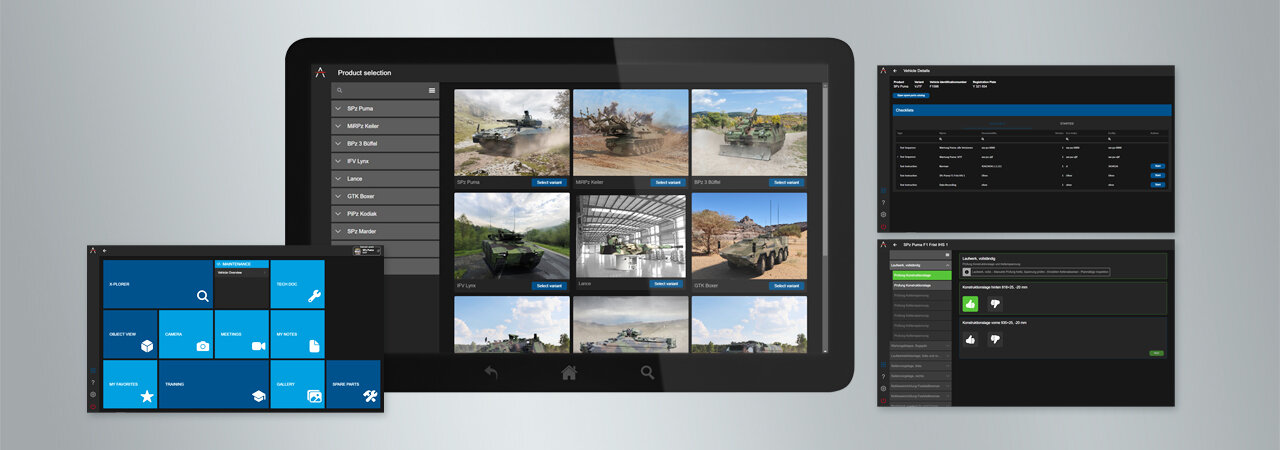
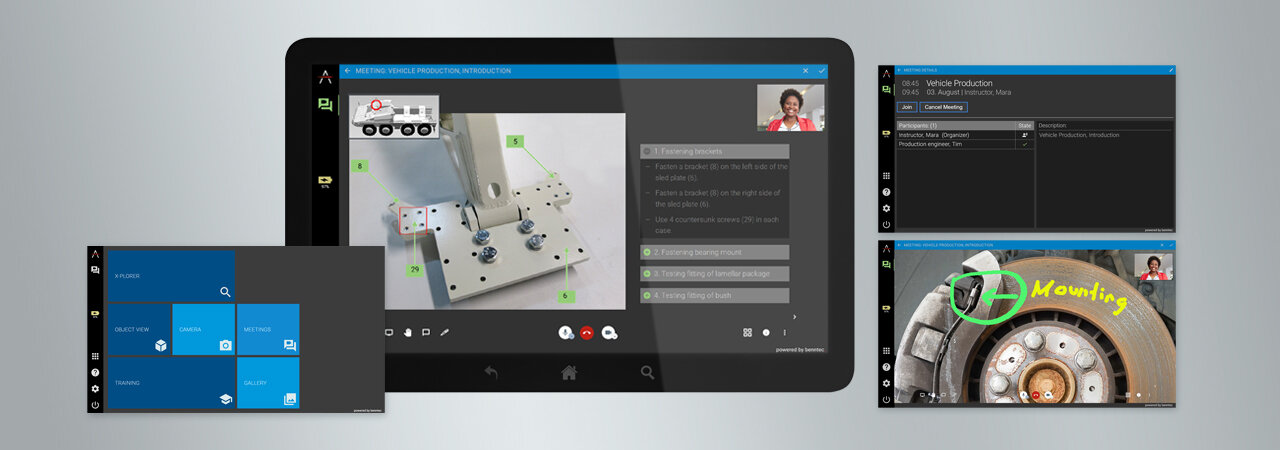
XERENA is an incredibly versatile mobile support tool for training, collaboration, maintenance, and service. Seamlessly integrating service knowledge with technical documentation and training, XERENA supports work both on-site and across multiple production locations. The tool is modular in design and provides real work convenience with on-demand content, learning modules, secure video conferences, and real-time access to information. XERENA offers a wide range of functions and formats for content display, including 3D visualizations, interactive panoramas, lecture and presentation features, augmented reality capabilities, and more.
Components, spare parts lists, documents, models, videos, etc.: By intelligently linking all available and relevant information, the right data for any task is always at hand. Through a smart search, content can be found quickly and purposefully. XERENA is based on an extensive security concept for protecting sensitive data. The requirements for controlled data exchange and secure end-to-end encryption are naturally fulfilled. XERENA consists of a server platform, mobile clients, and an administration application. All data is continuously synchronized, always up to date, and also available offline for mobile operations on-site.